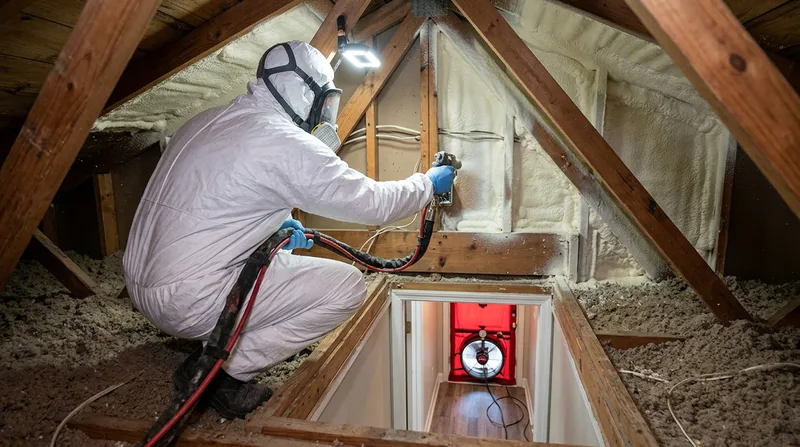




Air sealing in Gainesville stops humid air from leaking into your attic through gaps around top plates, ductwork chases, and penetrations. In this climate zone 2A heat and humidity never really let up, and vented attics pull in hot damp air year-round that works its way down through ceilings and into your conditioned space. Sealing those points cuts the stack effect, keeps your cooled air from escaping upward, and reduces the moisture load that drives your cooling bills up month after month. Whether you live in the historic Duckpond near campus, a mid-century block home in central Gainesville, or a newer two-story in Haile Plantation or Newberry, the same physics applies: gaps leak, and leaks cost money. We identify those points and seal them with spray foam to stop the cycle. Call us at (352) 450-6430 for a free estimate, or learn more about how attic spray foam insulation ties into a complete air sealing strategy.
Why Air Sealing Matters in Gainesville's Hot, Humid Climate
Gainesville sits in a climate where moisture pressure works inward almost every day of the year. Humidity never truly breaks here, and that steady damp air finds every gap it can. Your attic is the path of least resistance. Hot air rises, and in a vented attic with poor sealing, conditioned air escapes through ceiling cracks, around ductwork, and past top plates. That same pressure pulls humid outside air in through lower-level gaps, which then migrates upward and condenses on cooler surfaces. The result is steady moisture infiltration, higher cooling loads, and ductwork that works harder to recondition already-leaky air. Air sealing stops that cycle at the source.
- We locate and seal top plate gaps where exterior walls meet the attic framing.
- We seal ductwork penetrations where HVAC chases pass through the attic boundary.
- We close off plumbing and electrical chases that act as air highways into the conditioned space.
- We seal around recessed light fixtures and exhaust vent boots that leak significantly.
- We address rim and band joists in crawl space homes where air infiltration is especially severe.
Each of these points is a leak that costs you money every cooling season. Sealing them stops the waste and cuts your humidity load in one step.
Key info: In Gainesville and Alachua County, older homes with vented attics and flat, settled fiberglass insulation are especially vulnerable. The insulation no longer blocks air movement, and gaps around penetrations act like open doors. Mid-century block homes and student rentals near the University of Florida often have the worst sealing, with ductwork running unprotected through hot, damp attic air.
For more context on how air sealing fits into a broader insulation strategy, see our page on closed cell spray foam insulation, which is often paired with air sealing work in high-performance retrofits. You can also check Florida's building code guidance at floridabuilding.org for energy code requirements in your area.
How We Perform Air Sealing Work in Gainesville Homes
Air sealing is a systematic process that starts with a thorough inspection and ends with verified, durable results. We don't guess at gaps or assume they're sealed. We walk the attic, identify every major leak point, and seal them with the right material for the job. Most work involves spray foam, which adheres to wood, metal, and concrete and creates an airtight barrier that stays intact. The process is straightforward, non-invasive, and works in attics, crawl spaces, garages, and wall cavities.
- We inspect the attic or crawl space and mark all visible gaps, penetrations, and air leakage points.
- We discuss the scope with you, explain what we'll seal, and confirm the approach fits your budget and timeline.
- We set up mechanical ventilation to manage vapor and odor during the cure process.
- We apply spray foam to each gap and penetration, controlling thickness and coverage per manufacturer spec.
- We allow a 24 to 48 hour cure period before the space is fully re-occupied.
- We walk the job with you at completion and explain what was sealed and why.
The result is a controlled, documented air sealing that you can verify and that will hold for decades.
Example: A Haile Plantation two-story home with a sealed attic and ducted HVAC system typically has 15 to 25 major leak points around the attic boundary. A typical job takes a half-day to seal, costs between $800 and $1,500 depending on complexity, and cuts the home's air leakage by 30 to 50 percent. A mid-century block home in central Gainesville with a vented attic and crawl space often has 20 to 35 leak points and may require a full day and cost $1,200 to $2,000.
For homes that need both air sealing and new insulation, we often recommend open cell spray foam as a complementary solution, especially in attics where sound dampening and cost control matter. Learn more about how crawl space spray foam insulation pairs with air sealing in foundation-level moisture control.
Air Sealing Methods and Techniques
| Method | Application | Best for |
|---|---|---|
| Open Cell Spray Foam | Applied at 1.5 to 2 lb/ft3 density, fills cavities and conforms to irregular shapes. | Attic penetrations, top plate sealing, and ductwork chases in vented attics. |
| Closed Cell Spray Foam | Applied at 2.0 to 3.5 lb/ft3 density, creates a rigid, high-R barrier with vapor resistance. | Sealed attics, rim joists, crawl spaces, and areas where moisture control is critical. |
| Injection Foam into Walls | Low-pressure injection into closed wall cavities without demolition, typically open cell. | Retrofit air sealing of pre-1980 block and frame homes where interior walls must stay intact. |
| Caulk and Tape | Polyurethane caulk or weatherstripping for small gaps and seams; foam board tape for larger voids. | Small gaps, electrical outlet sealing, and supplemental sealing after foam work is complete. |
The choice of method depends on the location, the gap size, and whether vapor control is required. In Gainesville's humid climate, closed cell foam is often the best choice for rim joists and crawl spaces because it resists moisture infiltration. Open cell works well for attic penetrations where cost and sound dampening matter more than vapor resistance.
Air Sealing Cost in Gainesville: What to Expect
Air sealing costs in Gainesville typically start at around $650 for a small, straightforward job and rise based on the number of leak points, the difficulty of access, and the materials required. A typical mid-range attic air sealing job in a Gainesville home runs $1,000 to $1,800 depending on whether you're sealing an attic, a crawl space, or both. Larger homes with complex ductwork layouts or multiple penetrations can run $2,000 to $3,500 or more. The key factors that move the price are the size of the attic or crawl space, the number of gaps and penetrations, how easy it is to access them, and whether you're combining air sealing with new insulation or insulation removal.
Getting 2 or 3 estimates from different contractors is smart practice. A written estimate should include the R-value and thickness of any foam applied, the specific areas being sealed, and a clear total price with no surprises. Avoid any estimate that quotes a price per board foot without a site visit, or that promises work without a detailed inspection. For a full breakdown of pricing across all our services, visit our pricing page.
Call us at (352) 450-6430 for a free, no-obligation estimate. We'll walk your attic or crawl space, explain what needs sealing, and give you a firm price in writing before any work begins.
What to Look for When Hiring an Air Sealing Contractor Near Gainesville
Hiring the right spray foam and air sealing contractor is critical because poor work creates odor, incomplete sealing, and wasted money. A good contractor is transparent about credentials, clear about what they'll do, and willing to answer your questions. Here's how to vet any contractor you're considering, including us.
- Confirm the contractor is fully insured and ask to see a current certificate of insurance covering general liability and property damage.
- Ask for written references from recent air sealing jobs in Gainesville or nearby areas, and call at least two to ask about odor, timeline, and durability.
- Request a detailed written estimate that includes the areas to be sealed, the type and thickness of foam, R-value specs, and the total price with no per-board-foot guessing.
- Verify the contractor has mechanical ventilation equipment on site during application and will enforce a 24 to 48 hour re-entry window before the space is occupied.
- Ask whether the contractor handles permitting or simply helps you navigate what applies at your address, and whether there are any HOA or local code requirements for your specific job.
- Confirm the contractor offers a workmanship warranty of at least one year and can explain any manufacturer system warranties that may apply.
A local, independent contractor with a Gainesville address and local insurance is positioned to stand behind the work and be reachable if questions arise after the job. Avoid any contractor offering a price far below market, promising immediate re-entry, or unable to verify insurance and references. For more guidance and to request your free estimate, contact us today.
Air Sealing in Gainesville: Pricing Guide
| Service | Price | Details |
|---|---|---|
| Small attic air sealing | Starting at $650 | Top plate gaps and one or two ductwork penetrations, typically 30 to 60 minutes of spray work |
| Mid-range attic or crawl space | Starting at $1,000 | Full attic boundary sealing or crawl space rim joist work, 15 to 25 major leak points, half-day job |
| Large or complex sealing job | Starting at $1,800 | Multi-zone sealing, sealed attics with extensive ductwork, crawl space plus attic, full-day commitment |
| Combination sealing and insulation | On estimate | Air sealing paired with spray foam insulation or insulation removal requires site walk to calculate board feet |
| Travel | Included | No separate mileage fee or call charge for Gainesville and surrounding service areas within Alachua County |
| Free estimate | No obligation | Written estimate with R-value and thickness specs, response within 24 hours, call (352) 450-6430 |
Indicative pricing, the exact cost depends on square footage, finish, and site access. Free personalized estimate within 24h at (352) 450-6430.


