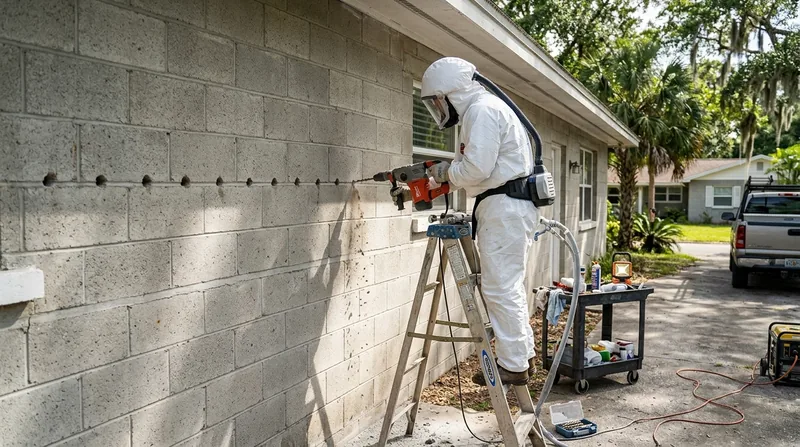




Wall & Injection Foam Insulation in Gainesville fills the cavities of mid-century block homes without tearing into walls or siding. Across Alachua County, thousands of post-1950 homes were built with hollow masonry block walls that were never properly insulated, leaving owners to fight rising cooling bills and uneven indoor temperatures year-round. The hot, humid climate of North Central Florida drives moisture inward most of the year, and poorly insulated walls let that damp heat migrate straight into conditioned space. Injection foam seals those cavities from the inside, drilling small holes and filling voids without exterior demolition or interior drywall damage. We inject closed cell or open cell foam depending on the wall type and performance goal, then patch the holes and finish flush. For homeowners in Gainesville, Alachua, and High Springs, this is the practical retrofit path when block walls are the problem.
Why Wall & Injection Foam Insulation Matters in Gainesville's Older Housing Stock
Mid-century block construction dominates neighborhoods across Alachua County, from central Gainesville out toward Archer and Newberry. These homes sit on slab foundations with hollow block walls that run the full height of the structure. When builders cut corners or omitted insulation entirely, those cavities became thermal highways. In a climate where outdoor temperatures climb into the 90s for four months straight and humidity rarely drops below 70 percent, uninsulated block walls transfer heat at a rate that air conditioning alone cannot match efficiently. Injection foam fills those voids with a continuous thermal barrier and an air seal, stopping the heat transfer and reducing the workload on cooling equipment.
- Hollow block walls conduct heat rapidly unless the cavities are filled with insulation or foam.
- Injection foam reaches into inaccessible cavities without removing interior drywall or exterior siding.
- The process seals air leaks at the same time, preventing humid outdoor air from infiltrating wall cavities.
- Mid-century block homes typically cool unevenly, with rooms farthest from the thermostat running hot.
- Filling wall cavities improves interior surface temperatures and reduces the temperature swing across rooms.
Homes with poorly insulated block walls are the most common retrofit candidate in Greater Gainesville, and injection foam is the only method that reaches those cavities without major construction.
Key info: A typical block home in Gainesville with 2,000 square feet of exterior wall space may have 40 to 60 linear feet of 8-inch hollow cavities running top to bottom. Filling those cavities with closed cell foam can reduce cooling load by 15 to 25 percent, depending on existing conditions and the home's orientation to afternoon sun.
For more information on how insulation affects your cooling costs, see our closed cell spray foam insulation page or contact the City of Gainesville Building Department for any questions about permits for your specific address.
How Wall & Injection Foam Insulation Works in Gainesville Homes
Injection foam is a drilling-and-filling process. We locate the hollow cavities in your block walls (or frame walls with inaccessible cavities), drill small access holes, and inject expanding foam into the void. The foam fills every corner and seals air leaks as it expands. Once cured, we patch the holes with trim or sealant and finish them to match the wall. The entire process is non-invasive, happens from inside or outside depending on wall access, and takes one to three days for a typical home. No drywall removal, no siding demolition, no months of reconstruction.
- We drill small diameter access holes (typically 1.5 to 2 inches) at intervals along the wall cavity.
- Foam is injected at low pressure to fill the void completely without forcing foam into adjacent cavities.
- The foam expands slightly and hardens, creating a rigid thermal barrier bonded to the block or framing.
- Holes are patched with foam-compatible sealant or wood trim, then painted or finished to blend with the wall.
- The wall is ready for normal use immediately after the foam has cured, typically 24 to 48 hours.
In a Gainesville block home, injection foam reaches cavities that blown-in insulation or fiberglass batts cannot access without demolition.
Example: A 1965 block home in High Springs with 1,200 square feet of uninsulated block wall and 8-inch cavities typically takes two days to inject and finish. We drill and inject from inside, patch with foam and trim, and the homeowner sees cooler rooms and lower summer bills within the first month of operation. The process costs significantly less than tearing out the wall and rebuilding it with new insulation.
For homes with air sealing needs beyond the wall cavities, we can address rim joists, band joists, and other thermal weak points in the same visit.
Wall & Injection Foam Insulation Methods and Approaches
| Approach | Description | Best For |
|---|---|---|
| Closed Cell Injection Foam | High-density foam (3.5 to 3.6 lbs/cu ft) with an R-value of 6.0 to 6.5 per inch. Creates a moisture barrier and rigid thermal seal. Requires mechanical ventilation during application and a 24 to 48-hour re-entry window. | Uninsulated block walls in hot, humid climates. Provides both thermal resistance and vapor control. Ideal for Gainesville block homes where moisture infiltration is a concern. |
| Open Cell Injection Foam | Lower-density foam (0.5 to 1.5 lbs/cu ft) with an R-value of 3.5 to 3.8 per inch. Expands more and is easier to inject into tight spaces. Allows drying if moisture enters, but does not create a vapor barrier. | Retrofit walls where R-value per inch is less critical than cost and ease of injection. Sound dampening and air sealing in frame walls. Secondary choice in Gainesville's high-humidity climate. |
| Partial-Fill Injection | Foam injected to a specific height or depth within a cavity, stopping before the cavity is completely full. Allows drying paths and reduces material cost while still improving thermal performance. | Budget-conscious retrofits or frame walls where some existing insulation remains. Useful when cavity geometry or building history makes full fill impractical. |
| Full-Cavity Injection with Barrier | Complete filling of block or frame cavities with closed cell foam, creating a continuous thermal and vapor barrier. Requires careful hole placement and pressure control to avoid over-pressurization. | Maximum performance retrofit. Standard approach in Gainesville for mid-century block homes where moisture and heat transfer are both problems. |
Wall & Injection Foam Insulation Cost in Gainesville: What to Expect
Wall and injection foam insulation in Gainesville typically starts at $2 per square foot of wall cavity filled, with most mid-century block homes in the $2 to $4 per square foot range depending on wall height, cavity width, and foam type. A 2,000-square-foot home with 40 linear feet of 8-inch cavities running 12 feet tall would have roughly 4,800 square feet of cavity surface, translating to a project cost in the $9,600 to $19,200 range for closed cell foam. Open cell injection is typically 20 to 30 percent less expensive but offers lower R-value per inch. The cost per square foot moves up if cavities are blocked by old mortar, debris, or structural elements that require extra drilling or careful pressure management. Travel is included within Gainesville and surrounding areas, so there is no separate mileage charge.
Several factors affect the final cost. Cavity accessibility determines whether we drill from inside or outside, and whether we need scaffolding or lifts. Foam type (closed cell versus open cell) carries different material and application costs. Wall height and linear footage of cavities directly scale the job. Existing obstructions such as wiring, plumbing, or blocked cavities may require extra drilling or inspection to work around safely. The best way to understand your specific cost is to request a free written estimate with R-value and thickness specifications. We inspect your walls on site, measure the cavities, and provide a firm number before any work begins.
For a detailed pricing overview across all our services, visit our pricing page. Call us at (352) 450-6430 for a free estimate tailored to your home and wall condition.
What to Look for When Hiring a Wall & Injection Foam Contractor Near Me in Gainesville
Choosing the right spray foam contractor is critical because poor installation leads to incomplete fill, uneven R-value, chemical smell that lingers, or moisture problems that become visible months later. The market includes rig-and-run crews from out of state who spray a job in an afternoon and disappear, national franchises with high overhead and no local accountability, and local shops that stand behind their work and remain reachable when questions arise. When evaluating any contractor, including us, verify their insurance, ask for written estimates with R-value and thickness specifications (not just a price), check references from homes they have worked on locally, and understand what permits apply to your address.
- Request proof of full insurance coverage and ask to see the certificate of insurance for your job.
- Get written estimates from at least two contractors, each specifying the foam type, R-value per inch, and thickness of each application pass.
- Ask for references from three to five homes in Gainesville or nearby that had wall injection work done in the past 12 months.
- Confirm that the contractor will provide mechanical ventilation during cure and a stated re-entry window of 24 to 48 hours.
- Understand that permits and contractor registration requirements vary by city, and verify what applies to your address with the local building department.
- Check that the contractor will inspect your walls before estimating and will explain why certain cavities cannot be filled safely.
A reputable local contractor will answer these questions directly and provide documentation. If an estimate comes with no R-value, no thickness specs, a price far below market, no reference list, or promises of immediate re-entry, that is a signal to look elsewhere.
Contact us at our contact page or call (352) 450-6430 to request a free estimate. We inspect your walls, explain the options, and provide a written quote with all specifications before any work begins.
Wall & Injection Foam Insulation in Gainesville: Pricing Guide
| Service | Price | Details |
|---|---|---|
| Closed Cell Injection Foam | Starting at $2.50/sq ft | Higher R-value (6.0 to 6.5 per inch), vapor barrier, best for humid Gainesville climate and uninsulated block walls |
| Open Cell Injection Foam | Starting at $1.75/sq ft | Lower cost, easier injection into tight spaces, R-value 3.5 to 3.8 per inch, allows drying if moisture occurs |
| Typical mid-century block home retrofit | On estimate | Average 2,000 sq ft home with 4,800 sq ft of cavity surface runs $9,600 to $19,200 depending on foam type and wall access |
| Full-cavity fill with preparation and patching | Included in per-sq-ft rate | Drilling, injecting, curing, patching holes with foam sealant or trim, painting to match wall finish |
| Travel within Gainesville and surrounding areas | Included | No separate mileage charge or travel fee for jobs in Gainesville, Alachua, High Springs, Archer, Newberry, and nearby cities |
| Free written estimate | Free | On-site inspection with R-value and thickness specifications, response within 24 hours, no obligation to book |
Indicative pricing, the exact cost depends on square footage, finish, and site access. Free personalized estimate within 24h at (352) 450-6430.


