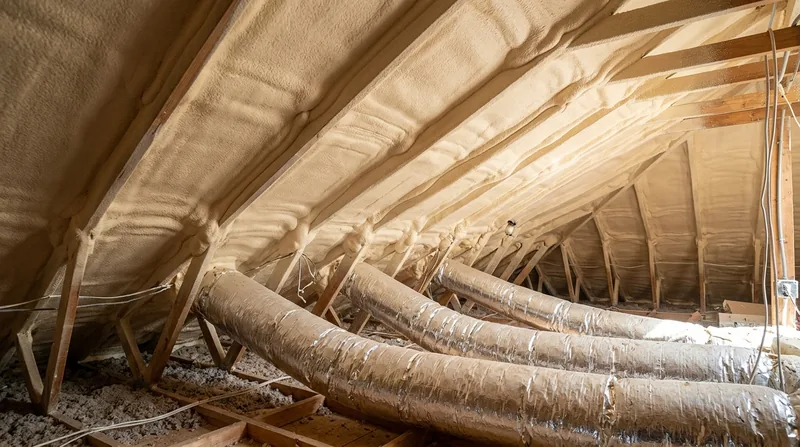




Attic spray foam insulation in Gainesville transforms a hot, leaky attic into a conditioned space that keeps your cooling bills down and your ductwork safe from the summer heat. Gainesville's attics bake under zone 2A sun for months on end, pulling humid air through ridge and soffit vents while your air conditioning fights to cool rooms above unconditioned space. The housing stock here spans everything from historic Duckpond homes on crawl spaces to mid-century block homes with settled, flat insulation, to newer two-story homes toward Haile Plantation with large attic volumes and ductwork running through uncontrolled heat. We spray closed-cell or open-cell foam directly to the roof deck to create a sealed, conditioned attic that keeps moisture and heat where they belong: outside. This section explains why attic foam works in Gainesville, how we install it, what it costs, and what to look for when hiring a contractor to do the job right.
Why Attic Spray Foam Insulation Matters in Gainesville's Hot, Humid Climate
Gainesville sits in a climate where moisture never really lets up. Humidity drives inward most of the year, and vented attics pull in hot, damp air that works its way down through ceilings and ductwork. Attic temperatures climb well above 140 degrees in summer, and that heat radiates down into living spaces and onto air conditioning ducts, forcing your system to work overtime. Traditional fiberglass or cellulose insulation settles flat over time, leaving gaps around penetrations and along rim joists where air leaks directly into your home. Spray foam seals every crack, every joist, and every duct penetration in a single application, stopping the moisture and heat before they enter your conditioned space.
- We spray foam directly to the underside of the roof deck, creating an unvented attic that becomes part of your conditioned envelope.
- Sealed attics eliminate the constant exchange of outdoor humidity with indoor air, reducing the load on your dehumidifier and air conditioning system.
- Ductwork sealed inside a foam-insulated attic stays cool and efficient, no longer losing conditioned air to leaks in a hot, vented space.
- A properly sealed attic stops air infiltration at rim joists, band joists, and soffit areas where fiberglass alone cannot compete.
The result is lower cooling bills, better humidity control, and rooms that stay comfortable even in peak summer heat. For homeowners in Gainesville and surrounding areas, attic foam is the single most effective way to reclaim energy efficiency from a space that was designed to be vented and hot.
Key info: In zone 2A, vented attics pull in approximately 1,200 to 1,500 cubic feet per minute of outside air through soffit vents during the cooling season. Sealed attics with spray foam stop that infiltration entirely, which is why energy codes now permit and encourage unvented attics in hot, humid climates. The Florida Building Code governs attic ventilation and thermal barrier requirements at your address; always check with the local building department before starting work.
How We Install Attic Spray Foam Insulation in Gainesville
Our process begins with a site inspection to understand your attic's current condition, access points, and any existing insulation that needs removal or work around. We identify all air leaks, penetrations, and areas where foam will create the thermal and air barrier. If your attic has old, settled, or contaminated insulation, we remove it first and dispose of it properly. We then set up mechanical ventilation to manage off-gassing during the spray, protect your home's interior from overspray, and ensure safe working conditions for our crew and your family. Once the attic is prepped, we spray foam to the specified thickness and R-value, seal all penetrations and rim joists, and verify that the cure process is complete before re-entry.
- We inspect the attic, measure square footage, and identify all air leaks, ductwork, and electrical penetrations that need sealing.
- We remove existing insulation if it is settled, wet, contaminated, or specified for replacement in your estimate.
- We install mechanical ventilation during the spray to manage fumes and ensure safe air quality for the cure period.
- We spray closed-cell or open-cell foam to the roof deck at the thickness and R-value specified in your written estimate.
- We seal all rim joists, band joists, soffit areas, and duct penetrations to create a complete air barrier.
- We confirm cure time, typically 24 to 48 hours, and provide clear re-entry guidance before you return to normal use.
Every job includes a written estimate with R-value and thickness specifications so you know exactly what you are paying for. For more detail on the methods we use, see our page on closed-cell spray foam insulation and open-cell spray foam insulation to understand which product is right for your attic.
Example: A 1,200-square-foot attic in Gainesville with old, flat fiberglass insulation and a vented roof deck typically takes one to two days to spray with closed-cell foam to R-30 or R-38, including insulation removal and mechanical ventilation during cure. Open-cell foam for the same space takes similar time and results in a lower cost but a lower R-value per inch, so it is better suited to attics where you have plenty of vertical space and cost is the priority.
Attic Spray Foam Insulation Methods and Approaches
| Approach | Description | Best for |
|---|---|---|
| Closed-Cell Spray Foam | Dense, rigid foam with high R-value per inch (approximately R-6 to R-7). Provides air sealing, moisture barrier, and structural support. Requires precise equipment, ratio, and temperature control. | Sealed attics where space is limited, moisture control is critical, and you want maximum R-value in minimal depth. Standard choice for zone 2A humid climates. |
| Open-Cell Spray Foam | Lighter, softer foam with lower R-value per inch (approximately R-3.5 to R-4). Allows some vapor permeability and is less dense. Lower material cost than closed-cell. | Attics with ample vertical space, where cost is a primary concern, and where you do not need a vapor barrier. Less common in Gainesville due to humidity, but viable in dry climates or as a secondary layer. |
| Foam Top-Up Over Existing Insulation | Spray a thin layer of closed-cell foam over sound, settled insulation to add R-value and seal air leaks without removing the old material. | Attics where insulation is in good condition but has lost effectiveness due to settling. Faster and cheaper than full removal and replacement. |
| Full Removal and Replacement | Remove all existing insulation, clean the attic deck, and spray new foam to specification. Handles wet, contaminated, or severely settled material. | Attics with water damage, mold indicators, pest contamination, or insulation so flat it offers no thermal resistance. Most common retrofit in older Gainesville homes. |
Each approach has a different cost and timeline. A simple top-up of sound insulation is faster and cheaper; a full removal and replacement takes longer but delivers a better long-term result. During your free estimate, we help you decide which method makes sense for your attic's condition and your budget.
Attic Spray Foam Insulation Cost in Gainesville: What to Expect
Attic spray foam insulation in Gainesville typically starts at $1.50 per square foot for a straightforward closed-cell application to the roof deck, including basic air sealing of rim joists and penetrations. The final price depends on several factors: the total square footage of your attic, whether you need insulation removal (which adds time and labor), the R-value and thickness you choose, access difficulty, and the complexity of ductwork or electrical systems that need sealing. A 1,000-square-foot attic with simple access and no removal might run $1,500 to $2,000; a 2,000-square-foot space with removal and complex penetrations could reach $4,000 to $6,000 or more. Open-cell foam costs less per square foot but delivers lower R-value, so the total project cost may not differ as much as the per-foot rate suggests.
We always provide a written estimate with R-value and thickness specifications so you know exactly what you are paying for before work begins. The estimate includes the cost of removal (if needed), mechanical ventilation during cure, and all air sealing. We recommend getting two or three estimates from local contractors to compare scope, materials, and pricing. Visit our pricing page for more detail on what drives cost up or down, and call us at (352) 450-6430 for a free, no-obligation estimate.
Attic Spray Foam Insulation Near Me: What Gainesville Homeowners Should Know When Hiring a Contractor
Hiring the right spray foam contractor is critical. The insulation trade has both rig-and-run crews (out-of-state trailers, jobs sprayed in an afternoon, nobody reachable when the smell will not go away) and national franchises, and the local independent contractor is often the best choice. Look for a contractor who is fully insured, can provide references from local jobs, and gives you a written estimate with R-value and thickness spelled out. Ask how they handle mechanical ventilation during the spray and what re-entry window they specify. Check whether your city or county requires a permit for the work and confirm that the contractor understands local building code requirements for thermal barriers and ventilation. If your home is in an HOA, check whether architectural approval is needed for any exterior work or equipment staging.
- Verify that the contractor is fully insured and can provide a current certificate of insurance for your records.
- Ask for at least two local references from attic foam jobs completed in the past two years in Gainesville or nearby.
- Request a written estimate that includes square footage, R-value, foam thickness, removal costs (if any), and the total project price.
- Confirm that the contractor uses mechanical ventilation during the spray and specifies a 24 to 48-hour re-entry window before the attic is safe to occupy.
- Check with your city or county building department to understand whether a permit is required for attic insulation work at your address.
- If you live in a master-planned community, verify that your HOA has no restrictions on staging equipment or exterior work during the project.
When you are ready to move forward, contact us for a free estimate. We have been serving Gainesville and Alachua County since 2012, and we stand behind every job with clear communication, honest pricing, and a commitment to getting it right the first time.
Attic Spray Foam Insulation in Gainesville: Pricing Guide
| Service | Price | Details |
|---|---|---|
| Closed-Cell Spray Foam Attic Insulation | Starting at $1.50/sq ft | Sealed attic to roof deck, R-30 to R-38, includes air sealing and rim joist work |
| Open-Cell Spray Foam Attic Insulation | Starting at $1.00/sq ft | Lower-cost option for attics with ample vertical space, R-3.5 per inch, full air sealing included |
| Insulation Removal and Replacement | On estimate | Removal cost depends on volume, contamination level, and disposal method; always quoted separately from foam application |
| Foam Top-Up Over Existing Insulation | Starting at $0.75/sq ft | Thin closed-cell layer over sound settled insulation, adds R-value and seals air leaks without full removal |
| Travel and Mobilization | Included | No separate mileage or call-out fee within Gainesville and surrounding Alachua County service areas |
| Free Written Estimate | Free | Response within 24 hours at (352) 450-6430, includes R-value and thickness specifications, no obligation to book |
Indicative pricing, the exact cost depends on square footage, finish, and site access. Free personalized estimate within 24h at (352) 450-6430.


